



How to Choose the Right Guttering Profiles for Your Home
Key takeaways
- Half-round guttering is the most practical all-round profile for UK homes, offering good flow and easy cleaning.
- Roof size and rainfall intensity determine the required gutter size, with 75mm for small roofs, 112mm/125mm for medium, and 150mm or deep-flow for large roofs.
- A standard UK rainfall intensity of 75mm per hour is used for sizing, but high rainfall areas need a larger profile.
- Downpipe size must match the gutter capacity; 65mm or 68mm downpipes suit smaller profiles, while 150mm gutters need a 110mm downpipe.
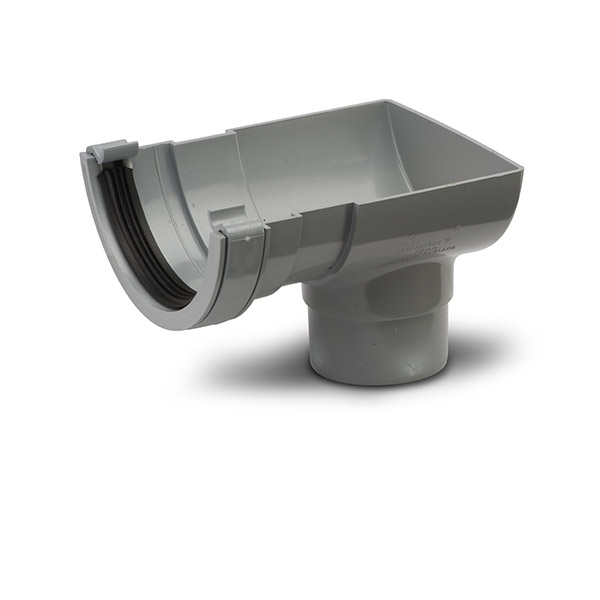
- Always match the profile of outlets and stopends to the gutter, such as the Polypipe 75mm Half Round Gutter Stop End Outlet for 75mm half-round systems.
Choosing the right guttering profiles is not just about kerb appeal. The profile you select directly affects how much rainwater your system can carry, how often it needs cleaning, and how well it suits your roof size and local rainfall. In this guide, I will compare the main guttering profiles sold in the UK, explain how to size a system correctly, and show you which fittings matter most for a leak-free installation.
What are the main guttering profiles available in the UK?
Most UK homes use one of four guttering profiles: half-round, square, ogee, or deep-flow. Each has a different cross-section shape, which changes the flow capacity, visual style, and typical installation details.
- Half-round guttering is the traditional curved profile. It has the highest capacity for its width compared with square and ogee, because the semicircular shape allows water to flow smoothly without corners. It is also the easiest to clean.
- Square guttering has a flat back and angular front. It looks modern and works well with contemporary architecture, but debris can collect in the corners and reduce flow more quickly.
- Ogee guttering is a decorative profile with a curved front face and a flat back, often used on period or style-conscious homes. Its capacity is generally lower than half-round of the same width because of the elaborate shape.
- Deep-flow guttering is a half-round profile with a deeper channel. It is designed for larger roofs or areas with heavy rainfall, offering a significantly higher flow rate than a standard half-round of the same width.
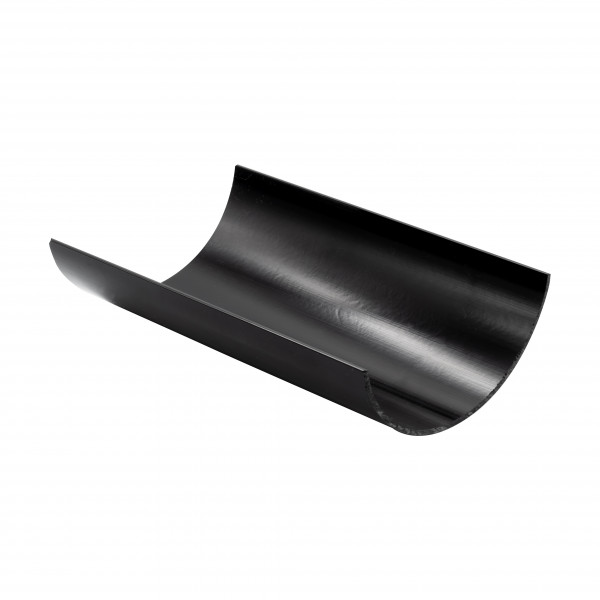
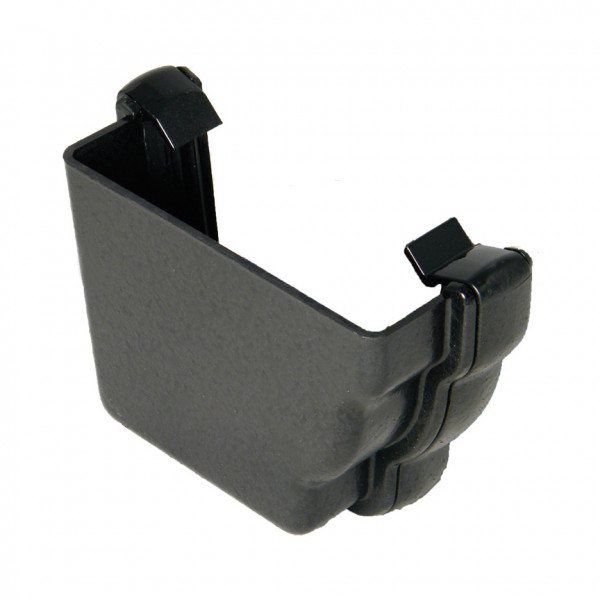
At Plumin Online, we stock a wide range of rainwater systems covering all these profiles. For example, the FloPlast Half Round 2M Gutter in Black is a standard half-round profile suitable for short runs, repairs and smaller rooflines, while the FloPlast Niagara Ogee External Stopend shows how ogee profiles are often finished with heritage-style fittings.
How do I choose between half-round, square, ogee and deep-flow guttering?
Start with three practical questions: How large is your roof? How much rain does your area receive? What look do you want? Then match the profile to the requirement.
- For standard terraced, semi-detached or small detached homes with a roof area up to about 40 square metres, a 75mm half-round system is usually adequate. The Polypipe 75mm Half Round Gutter Stop End Outlet is a typical outlet fitting for this size.
- For larger detached homes, extensions or shallow-pitch roofs with a roof area between 40 and 80 square metres, a 112mm or 125mm half-round, square or ogee profile is more suitable. Many modern square systems use a 65mm square downpipe, such as the FloPlast Square Downpipe 65mm Pipe Socket.
- For very large roofs, long gutter runs, or areas with high rainfall, choose a 150mm deep-flow or 150mm half-round profile. The Polypipe 150mm Half Round Gutter Stop End External is an external stopend designed for this larger profile.
- For period properties or conservation areas, ogee guttering in cast iron effect or black is often the best match. Ogee profiles are decorative, so they suit Victorian, Edwardian and Georgian homes better than a plain square profile.
How does roof size affect guttering profile choice?
Roof size is the single most important factor in sizing a rainwater system. The key measurement is the effective roof area, which is the plan area of the roof that drains into one gutter run. You calculate it by multiplying the roof length by the roof width, but you must also add a pitch factor because a steep roof catches more rain per square metre of plan area.
As a general guide for UK conditions:
- Up to 40 square metres of effective roof area: 75mm half-round or square gutter with a 68mm downpipe.
- 40 to 80 square metres: 112mm or 125mm half-round, square or ogee gutter with a 68mm downpipe.
- 80 to 150 square metres: 150mm half-round or deep-flow gutter with a 110mm downpipe.
- Over 150 square metres: you will need multiple downpipes or a bespoke design, often with 150mm deep-flow gutter and multiple outlets.
These figures assume a typical UK rainfall intensity of about 75mm per hour for a short duration storm. If you live in an area with exceptionally high rainfall, such as parts of Cumbria, western Scotland or Snowdonia, increase the capacity by moving up one profile size.
How does rainfall intensity affect guttering sizing?
Rainfall intensity is the rate at which rain falls, usually measured in millimetres per hour. UK building practice generally designs roof drainage for a storm of about 75mm per hour, but local rainfall data can exceed this. The more intense the rain, the faster water runs off the roof, and the larger the gutter and downpipe need to be.
To account for rainfall, you can use the following method. First, calculate the effective roof area in square metres. Then multiply by the rainfall intensity in litres per second per square metre. A rainfall intensity of 75mm per hour equals approximately 0.0208 litres per second per square metre. So a 50 square metre roof would produce about 1.04 litres per second. A standard 75mm half-round gutter can typically handle around 1.0 to 1.5 litres per second when laid level and fitted with a correctly sized outlet, but this drops if the gutter is long, has many bends, or is poorly maintained.
For higher rainfall areas, or for roofs over 80 square metres, switch to a 112mm or 150mm profile. The Polypipe 150mm Half Round Gutter Stop End External is part of a larger system that can handle significantly more flow than a 75mm profile.
What downpipe size goes with each guttering profile?
Downpipes are often overlooked but they are critical. A downpipe that is too small will restrict the flow and cause the gutter to overflow, even if the gutter itself is large enough. Standard UK downpipe sizes are 65mm round, 68mm round, 65mm square, and 110mm round.
- 75mm half-round and 112mm half-round or square gutters typically use a 65mm or 68mm downpipe. For example, a 112mm half-round gutter can be connected to a 68mm round downpipe.
- 150mm half-round and deep-flow gutters need a 110mm downpipe to match the higher flow capacity.
- Some square systems use a 65mm square downpipe, which has a slightly different internal area to a 65mm round downpipe. The FloPlast Square Downpipe 65mm Pipe Socket is a typical connector for square downpipes in anthracite grey.
Always check the manufacturer's technical data for the exact flow rate of the gutter and downpipe combination. A mismatch is a common cause of overflowing gutters.
Do I need an outlet or stopend for each guttering profile?
Yes. Every gutter run needs two types of terminal fittings: an outlet, which connects the gutter to the downpipe, and a stopend, which closes off the open end of a gutter run. The profile and size of these fittings must match the gutter you have chosen.
For a 75mm half-round system, the Polypipe 75mm Half Round Gutter Stop End Outlet serves as both a stopend and an outlet in one fitting. It is fitted at the end of a gutter run and connects directly to a downpipe. For a 150mm half-round system, the Polypipe 150mm Half Round Gutter Stop End External is an external stopend used to close off the end of a run. For ogee systems, you often need left-hand and right-hand stopends, such as the FloPlast Niagara Ogee External Stopend LH 110mm in Cast Iron. Always check the profile and size before ordering fittings, because a half-round stopend will not fit a square or ogee gutter.
Which guttering profile is easiest to maintain?
Half-round guttering is widely regarded as the easiest to maintain because it has no internal corners where debris can collect. The curved profile encourages water to flush leaves and silt towards the outlet, provided the gutter is installed with a slight fall towards the outlet. Square and ogee profiles are more prone to debris build-up in their corners, so they may require more frequent cleaning. Deep-flow gutter has the same smooth internal curve as half-round but with a deeper channel, so it also performs well in terms of self-cleaning, although its larger capacity means you may clean it less often because it can carry more water before overflowing.
Can I mix different guttering profiles on the same house?
In principle, you can mix profiles if you use the correct adaptors and connectors, but in practice it is rarely a good idea. Different profiles have different bracket types, outlet shapes and joint details. Mixing them often leads to weak joints, leaks and an inconsistent appearance. The only common exception is using a square downpipe with a half-round gutter, because many manufacturers offer a compatible outlet that connects a half-round gutter to a square downpipe. However, you should never mix brands or profiles without checking the manufacturer's compatibility data. Stick to one profile, one size, and one brand for the whole roof drainage system.
What is the best guttering profile for a UK home?
For most UK homes, half-round guttering in 112mm or 125mm is the best all-round choice. It offers good flow capacity, is easy to clean, and suits both traditional and modern properties. Ogee is the best choice for period homes where appearance matters more than maximum flow. Square guttering suits contemporary new builds and extensions. Deep-flow is the best choice for large roofs, long runs, or areas with high rainfall, especially if you want to minimise the number of downpipes.
Before you buy, measure your effective roof area, check your local rainfall intensity, and decide on the visual style. That will narrow the choice to one or two profiles. Then select the matching fittings, outlets and downpipes from the same manufacturer's range. A well-chosen guttering profile will protect your home for decades without overflowing, blocking or detracting from the building's appearance.
Frequently Asked Questions
What is the most common guttering profile in the UK?
Half-round guttering is the most common profile in the UK. It is widely available, easy to clean, and provides good flow capacity for typical domestic roofs.
Can I use ogee guttering on a modern house?
Yes, you can use ogee guttering on a modern house, but it is more commonly fitted to period or traditional properties. Ogee has a decorative appearance that may look out of place on a very modern building unless you deliberately want a style contrast.
What size guttering do I need for a large roof?
For a roof with an effective area over 80 square metres, use a 150mm half-round or deep-flow gutter with a 110mm downpipe. For roofs over 150 square metres, you will likely need multiple downpipes or a bespoke design.
Is deep-flow guttering worth it?
Deep-flow guttering is worth it if you have a large roof, a long gutter run, or live in a high rainfall area. It carries significantly more water than standard half-round of the same width, reducing the risk of overflow.
How do I calculate effective roof area for guttering?
Multiply the plan length of the roof by the plan width, then multiply by a pitch factor. For a roof pitch of 30 degrees, the pitch factor is about 1.15. For 45 degrees, it is about 1.4. Add the result for each roof slope draining into that gutter run.
Can I fit a square downpipe to half-round guttering?
Yes, many manufacturers supply an outlet that connects a half-round gutter to a square downpipe. Check the manufacturer's technical information to confirm the outlet is compatible with both profile shapes.
Frequently asked questions
What is the difference between half-round and ogee guttering?
Half-round guttering has a simple semicircular profile with smooth flow and easy cleaning. Ogee guttering has a decorative curved front face and flat back, often used on period homes, but it has slightly lower flow capacity for the same width.
How do I know if I need deep-flow guttering?
You need deep-flow guttering if your effective roof area exceeds about 80 square metres, if you have a long gutter run, or if you live in an area with high rainfall intensity. Deep-flow carries significantly more water than standard half-round of the same width.
What size downpipe goes with 150mm guttering?
A 150mm half-round or deep-flow gutter should be connected to a 110mm downpipe. A smaller downpipe would restrict flow and cause the gutter to overflow.
Can I use the same brackets for different guttering profiles?
No, brackets are profile-specific. A half-round bracket will not hold a square or ogee gutter correctly. Always use the manufacturer's recommended bracket for the exact profile and size.
What is the best guttering profile for a bungalow?
For a typical bungalow with a roof area up to 60 square metres, a 112mm half-round or square profile is usually sufficient. If the bungalow has a wide roof span or is in a high rainfall area, consider 150mm half-round or deep-flow.
Products mentioned in this article

Floplast 65mm Square Downpipe Pipe Socket - Anthracite Grey (RSS1AG)
£2.34 (Inc VAT)

Polypipe 150mm Half Round Gutter External Stop End - Grey (RL607G)
£12.54 (Inc VAT)
Polypipe 75mm Half Round Gutter Stop End Outlet - Grey (RM306G)
£7.37 (Inc VAT)
Floplast 112mm Half Round 2M Gutter - Black (RG2B)
£11.06 (Inc VAT)
Floplast Niagara 110mm Ogee Ext Stopend LH 110mm - Cast Iron (REN1CI)
£14.32 (Inc VAT)
Written by
James WhitfieldTechnical Sales Manager, Plumin Online
James has spent over fifteen years advising trade and self-build customers on plumbing and drainage systems. He leads the technical sales team at Plumin Online and specialises in matching the right pipe, fitting and system to the job.
Need the parts for the job?
Browse thousands of plumbing, drainage and heating products with fast UK delivery.
Shop all products